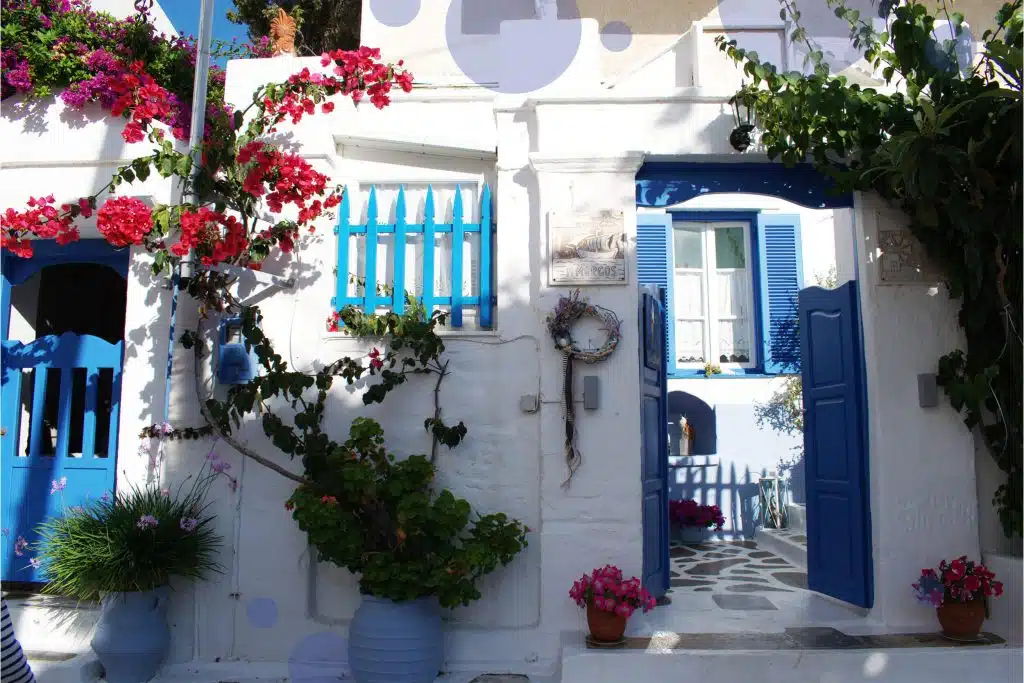
Infinitely instagrammable, the Greek island of Amorgos is where ‘real’ Greece endures. And alongside its seafront tavernas, whitewashed houses and blue domes of Greek churches, you’ll find a local drink that’s native to the tiny island.
Amorgos is a small Greek island in the Cyclades group of islands close to its better-known neighbours of Naxos and Paros, with a pretty town, hiking trails, and remote sandy beaches. It’s a favourite with travellers looking for an authentic Greek island experience meaning that Amorgos remained quiet and quite lazy. Amid the narrow winding streets and in the town, a sweet liqueur is served before meals, after meals, and drunk at weddings and other local celebrations.
It’s called Psimeni Raki, pronounced with a silent ‘p’. Psimeni Raki is only made here, on this small island and while you’ll find a handful of producers the amber coloured nectar is more often than not it’s hand-crafted by locals in their own homes.
What Is Psimeni Raki?

Raki describes a drink distilled from the by products of wine making, making full use of the vineyard and allowing for less waste. Raki is a clear spirit that’s similar to grappa and ouzo. What sets Raki apart is that it’s often made in different ways, meaning it is unique to the islands and countries it’s created in because ingredients are added that are particular to that place. On Amorgos the locals boil the raki—Psimeni means boiled or bakedi—and add sugar, cloves, cinnamon and honey. It tastes sweet and usually has a honey colour to it, but the interesting thing about Psimeni Raki is, just like raki itself, it isn’t made in a standard way. Because it’s historically homemade, and still mostly is, the Psimeni Raki you are served in a taverna or buy in a bottle from a store, differs from one glass to the next.
It’s unknown just how long Amorgions have been making Psimeni Raki, but it was certainly made in Ancient Greece – it’s also called Amorgion rakomelo, but shouldn’t be confused with the Cretan raki drink, Rakomelo, which contains fewer ingredients and is served warm, Psimeni Raki is served at room temperature and is brought out when guests arrive, when food is served and when there’s any hint of a celebration.
How Psimeni Raki Is Made
Raki is made from wine resin, called suma, and is twice distilled and sweetened. Usually, raki has aniseed added to it, but not always. Without aniseed it’s known as ‘straight raki’. To make Psimeni Raki, the people of Amorgos boil the raki and add their own ingredients. It’s here where the Psimeni Raki starts to take on its own life, its own flavour and its own appearance.
The amount of sugar added differs, depending on whether the person making it likes it sweet or less so. Honey and cloves are added and cinnamon, but the recipes alter from household to household and often where someone’s grandparents made it a certain way, that’s the way it stays in their family.
The main element of Psimeni Raki is the boiling of the raki, and this also differs from maker to maker. Some like to leave the raki boiling for longer than others. The length of time it’s boiled, coupled with how much sugar is added, contributes to the colour of the Psimeni Rake. The longer it’s boiled and the more sugar is added the darker it appears and the sweeter it tastes. Some Psimeni Raki is a yellow colour, which means it hasn’t been boiled for long and not so much sugar has been added. Some Amorgions like their Psimeni Raki bitter, some like it so sweet it looks almost like black treacle. Some add additional spices in the mix and some even add dried fruit to their Psimeni Raki.
Only on Amorgos
Psimeni Raki is a very special drink, especially if you’re an Amorgos. The people on this picture postcard island are rightly proud of their sweet liqueur, and the drink is so important to them every year, on July 26th, a festival is held in the drink’s honour.
The Psimeni Raki Festival takes place in Katapola’s main square by the harbour. It all kicks off when a boat is brought to the square carrying locals in traditional dress. The dancers disembark the boat where local musicians await them and everyone starts to dance. Visitors are encouraged to join in and everyone enjoys a glass or two of Psimeni Raki. It’s served with pasteli, the locally made sesame seed sweet bar with honey, and cheese pies. There’s also the chance to see how Psimeni Raki is made, as demonstrations take place in the square.
Psimeni Raki is also served at the monastery of Panagia Hozoviotissa, a striking building perched high up on the hillside. Monks at the monastery have traditionally kept some Psimeni Raki for any visitors, as a welcome, and you’ll still be offered the sweet liqueur in the gift shop area today.
Apart from its distinctive taste and the fact that it differs wildly in colour and sweetness depending on which taverna you stop at, the thing that makes Psimeni Raki so special is its rarity. It won’t be found in the supermarket and even when browsing online it’s hard to track any down.
For anyone who visits Amorgos it’s a must buy, as it’s almost impossible to purchase anywhere else. Almost, but not completely. It can be found it other parts of Greece, but only at specialist sellers. Here are a few of them:
Enjoy, and Στην υγειά μας!